
- Home
- Media Center
-
Events
- Wuzhen Summit
- Regional Forums
- Practice Cases of Jointly Building a Community with a Shared Future in Cyberspace
- World Internet Conference Awards for Pioneering Science and Technology
- The Light of Internet Expo
- Straight to Wuzhen Competition
- Global Youth Leadership Program
- WIC Distinguished Contribution Award
- Membership
- Research & Cooperation
- Digital Academy
-
Reports
- Collection of cases on Jointly Building a Community with a Shared Future in Cyberspace
- Collection of Shortlisted Achievements of World Internet Conference Awards for Pioneering Science and Technology
- Reports on Artificial Intelligence
- Reports on Cross—Border E—Commerce
- Reports on Data
- Outcomes of Think Tank Cooperation Program
- Series on Sovereignty in Cyberspace Theory and Practice
- Other Achievements
- About WIC
- 中文 | EN


China's Jiangsu unveils AI action plan to boost smart economy


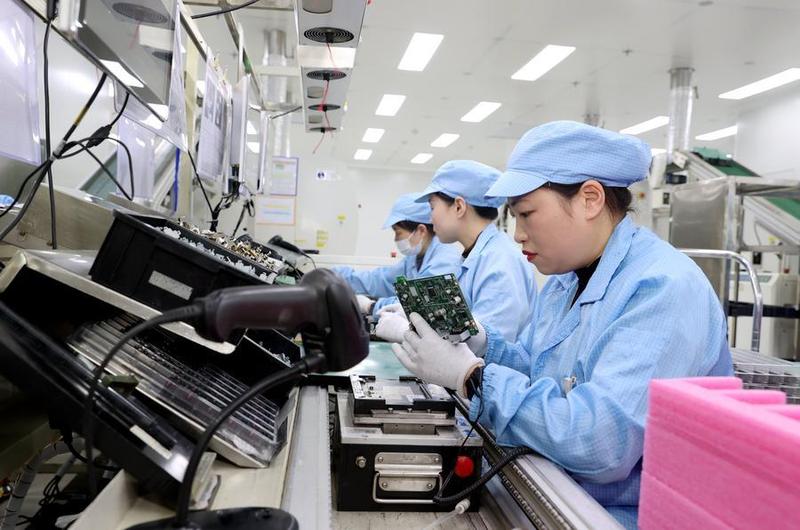
Workers operate on a production line of automotive intelligent central control navigation products at the workshop of a company in Suqian New & Hi-tech Industry Development Zone of Suqian city, East China's Jiangsu province, Jan 4, 2026. [Photo/Xinhua]
NANJING - East China's Jiangsu province plans to make the smart economy a key driver of its economic growth, according to a news conference held by the provincial government on Tuesday.
The Jiangsu provincial government unveiled the "Jiangsu Province Artificial Intelligence (AI) Plus Action Plan" at the conference, outlining its goals for the next few years. By 2030, Jiangsu will achieve a 90 percent adoption rate for new-generation smart terminals and intelligent devices, with the AI industry exceeding a scale of 1 trillion yuan ($142.6 billion).
Based on the six key actions outlined in the national "AI+" initiative, which focuses on scientific and technological advancements, industrial development, quality consumer goods, public welfare, governance capacity, and global cooperation, Jiangsu's action plan introduces a new direction for emerging industries. It includes fostering new intelligent business models, supporting the "AI+OPC (one person, one company)" innovation and entrepreneurship model, and positively engaging in strategic emerging industries such as humanoid robots, the low-altitude economy, intelligent driving, biomedicine, and new energy.
In addition to empowering industries with AI to accelerate the intelligent transformation of sectors such as manufacturing, agriculture and services, Jiangsu will also incorporate artificial intelligence across public services, including education, employment, healthcare, elderly care, transportation, and community services. Applications such as AI-assisted precision medicine and L4 autonomous driving have already been partially implemented, providing citizens with tangible improvements in quality of life and convenience enabled by digitalization and intelligence.
By 2035, Jiangsu is expected to become a leading hub for AI innovation, industrial development, and integrated applications, marking a new stage in the province's development into an intelligent economy and society, according to the action plan.
The World Internet Conference (WIC) was established as an international organization on July 12, 2022, headquartered in Beijing, China. It was jointly initiated by Global System for Mobile Communication Association (GSMA), National Computer Network Emergency Response Technical Team/Coordination Center of China (CNCERT), China Internet Network Information Center (CNNIC), Alibaba Group, Tencent, and Zhijiang Lab.